
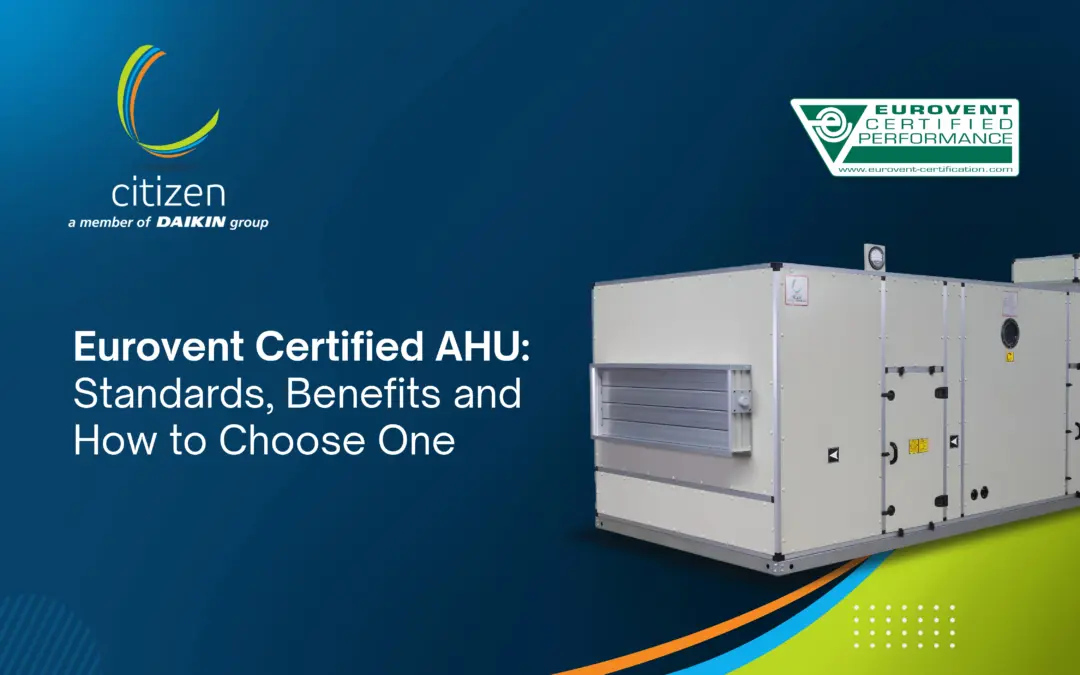
On tender days, most of the debate is about price. The quieter worry is whether the unit that lands on site will perform the way its datasheet promised. An Eurovent certified AHU takes much of that worry away, because an independent body has already checked the manufacturer’s numbers. Whether you are comparing air handling unit manufacturers for a hospital, an airport or a factory, this guide explains how the certification works, which standards sit behind it and how to choose well.
What is a Eurovent Certified AHU?
It is an air handling unit from a range that has passed the Eurovent Certified Performance (ECP) programme, run by Eurovent Certita Certification. In practice, the airflow, power, sound and heat recovery figures in the selection output have been verified by someone other than the manufacturer.
A range qualifies when it includes at least one size rated below 3 m³/s. A certify-all rule then applies: every in-scope unit built in the declared factory must be certified, so a company can’t certify one flagship range and leave the rest unchecked. An optional hygienic certification exists for sites with stricter cleanliness needs.
How Does Eurovent Certification Work?
Eurovent certification verifies three things a buyer can’t verify alone: the selection software, the factory and the finished unit. A claim is accepted only when all three agree with one another. The path runs like this:
- Scope declaration. The manufacturer names the range, the factory and every configuration it sells. Nothing gets added quietly later.
- Software check. The selection software behind your quotation is evaluated for accuracy and consistency. Only approved versions count, and they are listed on the certifier’s website.
- Model box testing. A sample casing is tested for strength, air leakage, thermal transmittance, thermal bridging and sound insulation under EN 1886.
- Real unit testing. A unit picked from the software is built and tested in an approved laboratory, with Eurovent’s representatives witnessing. Airflow, static pressure, power input, sound power, heat recovery and coil duty are measured and compared with what the software predicted. They must land within the tolerance the standard allows.
- Listing and energy class. Passing units appear in a public directory, and each receives a calculated energy class from A+ to E.
- Surveillance. Factory audits and repeat tests continue at set intervals for as long as the certificate is held.
The outcome is a datasheet that has been tested, not just stated. For you, that is the difference between selecting a unit and hoping it behaves.
Which Standards Apply to Eurovent Certified AHUs?
Four standards do most of the work: EN 1886 for the casing, EN 13053 for the complete unit, EN 308 for heat recovery and ISO 16890 for filters. Knowing what each covers tells you what to ask a supplier for.
| Standard | What it covers | Why it matters to you |
| EN 1886 | Casing strength, leakage, thermal and acoustic performance | Decides how rigid, airtight and well insulated the box is |
| EN 13053 | Rating and performance of the whole unit (non-residential, above 250 m³/h) | Source of the airflow, pressure, power, sound and heat recovery ratings |
| EN 308 | Test method for air-to-air heat recovery devices | Backs the heat recovery efficiency your energy savings depend on |
| ISO 16890 | Classification of general ventilation filters | Defines the filter grade you specify (it replaced EN 779 in Europe) |
The casing classes are the part you can write straight into a specification. A lower number means a stronger, tighter or better insulated box:
| Test | Classes | Limits | In Simple words |
| Casing strength (at +1000 Pa) | D1, D2, D3 | 4, 10, above 10 mm/m deflection | D1 flexes least under fan pressure |
| Casing air leakage (at −400 Pa) | L1, L2, L3 | 0.15, 0.44, 1.32 l/s per m² | Less lost air and less unfiltered air getting in |
| Thermal transmittance | T1 to T5 | T1 below 0.5, T2 up to 1.0, T3 up to 1.4, T4 up to 2.0 W/m²K | Heat lost through the panels |
| Thermal bridging | TB1 to TB5 | TB1 0.75 to 1.0, TB2 0.60 to 0.75, TB3 0.45 to 0.60 | Cold spots and condensation risk at frames |
| Filter bypass leakage | G1–F5 to F9 | 6%, 4%, 2%, 1%, 0.5% of airflow | Share of air that skips the filter |
Don’t chase the top class everywhere. L1 is normally kept for special applications such as cleanrooms. ISHRAE’s guidance asks specifiers to name classes in the range of D1 to D2, L1 to L3, T1 to T3 and TB1 to TB3 rather than leaving them open, and your design engineer should settle the final values for the application. Corrosion, fire behaviour and similar quality points sit outside these classes, and Eurovent’s Recommendation 6/18 covers them.
Eurovent Certified vs Just Tested to EN 1886: What’s the Difference?
A test report proves one sample passed one test. Eurovent certification proves that a whole range is checked, rechecked and open to public scrutiny. EN 1886 is a European standard, not a Eurovent one, and a casing report doesn’t turn an air handling unit into a Eurovent certified product.
| Check | Standalone test report | Eurovent certified |
| What is tested | One sample, once | Model boxes and real units from the declared range |
| Who arranges and witnesses it | Typically the manufacturer | Eurovent’s authorised representatives, in approved labs |
| Selection software | Not examined | Evaluated, with approved versions listed publicly |
| Factory | Not audited | Audited periodically |
| Repeat testing | Not required | At set intervals while certified |
| Energy class | None | Calculated, A+ to E |
| Proof you can check | A PDF from the supplier | Public directory listing, mark on printout and unit |
Watch for three red flags on a quotation: “tested as per EN 1886” with no directory listing, a Eurovent logo on the brochure but not on the selection printout, and a certificate for one range while the quoted unit comes from another. A two-minute directory search settles all three.
What Are the Benefits of Eurovent Certified AHU?
The main benefit is trustworthy numbers, and that changes what you buy, what you pay to run it and how the handover goes.
- No padding. When declared data is unreliable, designers add margin with bigger coils and larger fans. You pay for that margin at purchase and again on every power bill.
- A fair energy comparison. The A+ to E class weighs fan efficiency, air velocity, heat recovery efficiency and its pressure drop. Eurovent’s guidebook says energy can reach 80% of lifetime cost over a typical 15 to 20 years, so the lowest quote isn’t always the cheapest unit.
- Fewer faults hiding in the casing. Leakage, thermal bridging and filter bypass cause condensation, unfiltered air and wasted fan energy. Certified classes put a number on each before delivery.
- Easier comparison and handover. Every bidder’s figures come from audited software, and the same guidebook notes certification reduces the need for customer witness tests.
What Doesn’t Eurovent Certification Guarantee?
It guarantees honest declared performance. It doesn’t install the unit, commission the controls or change a clogged filter. Eurovent’s own quality guidance also notes that general criteria may not suit climate zones very different from Europe’s.
So add your own line items for Indian sites: corrosion protection near the coast, a filter grade that suits dusty outdoor air, drain pans that cope with monsoon humidity and a controller your BMS can read. Treat the certificate as the floor of your specification, not the ceiling.
How to Choose Eurovent Certified AHU
When you shortlist air handling unit manufacturers in India, run each one through these steps before comparing prices.
- Verify the certificate. Search the manufacturer and range in Eurovent’s certified product directory.
- Read the selection printout. Look for the Eurovent logo and an approved software version. Separate sheets for fans or coils suggest those parts sit outside certification.
- Write classes into the tender. Replace “good casing” with named strength, leakage, thermal transmittance and thermal bridging classes.
- Confirm the certified series. Match the certified range to the one actually being quoted.
- Look beyond the box. Fans, coils, drain pan, filter section and controls decide how the full air handling unit system behaves on site.
- Compare lifetime cost. Put energy class and running hours next to the price.
Eurovent Certified AHUs from Citizen Industries Pvt Ltd
We are an ahu manufacturing company based in Ahmedabad and a member of the Daikin Group, with plants at Santej and Hoskote. Our Euro series of AHUs is Eurovent certified, and our units also carry AHRI certification from the USA.
Inside, you will find internal coving so dust doesn’t settle in corners, double-skin insulated panels and a smart controller with 100+ inputs and outputs, ready for BACnet or Modbus. Our projects include Bengaluru International Airport, Micron’s semiconductor facility and Central Vista.
