
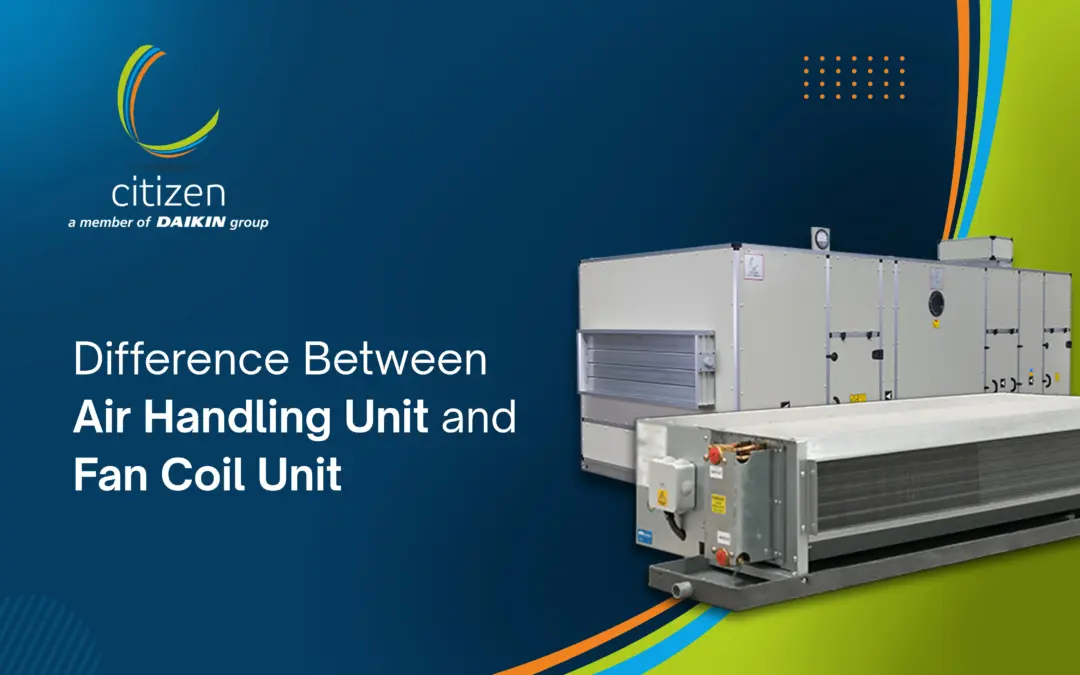
An air handling unit and a fan coil unit both condition and circulate air but they serve different purposes in an HVAC system. An AHU is primarily used for centralized air treatment, ventilation, filtration and air distribution, whereas an Fan Coil Unit is used primarily for localized heating or cooling in individual rooms or zones.
The difference is not simply about size or cooling capacity. Air source, ventilation, filtration, ductwork, humidity control, zoning, maintenance and operating requirements all influence the choice. In many commercial projects, the two units can also work together rather than being treated as alternatives.
Understanding these differences helps building owners, consultants and facility teams select equipment according to the actual requirements of the space.
Air Handling Unit vs Fan Coil Unit
Although both units can contain a fan, coil, filter and controls, their roles within an HVAC system are quite different. The most important distinction is what happens to the air before it reaches the occupied space.
Air source and ventilation
An air handling unit can be configured to handle outdoor air, return air or a mixture of both. Depending on the design, it can provide ventilation, filtration and other forms of air treatment before supplying air through the distribution system.
An FCU generally works with recirculated room air. It draws air from the space, passes it over its coil, and returns the conditioned air to the same zone. Therefore, an FCU should not automatically be considered a substitute for a dedicated ventilation arrangement.
This distinction is important because temperature control and ventilation are not the same function. A room may be adequately cooled while still requiring a separate source of outdoor air.
Air distribution and ductwork
An air handling unit is commonly connected to a duct network that carries conditioned air to multiple areas. The design of that network affects airflow, pressure loss, fan energy, noise and available ceiling or service space.
An FCU is normally installed close to the area it serves. It can supply air directly into the room or use relatively short duct connections, depending on the unit and project design. This makes it useful when independent zone control is more important than centralized air distribution.
Filtration and air treatment
An air handling unit offers greater flexibility in filtration and air-treatment arrangements. Depending on the application, the equipment can accommodate different filtration stages and components for heating, cooling or humidity control.
An FCU normally has a simpler filtration arrangement because its primary purpose is local conditioning of recirculated air. The required filtration level should always be decided according to the application rather than assuming that one equipment type automatically provides better air quality.
Temperature and humidity control
Both systems can provide cooling and, where designed for it, heating. However, the extent of air treatment can differ significantly.
An AHU can be configured for applications where temperature, humidity, airflow and air cleanliness need closer control. This becomes particularly important in healthcare, pharmaceutical, cleanroom and industrial environments.
An FCU is generally focused on maintaining the temperature of its served zone. It can be an effective choice where localized comfort control is the main requirement.
Zoning and individual control
A centralized AHU can serve several zones through a ducted distribution system, with the overall system controlled centrally or through zone-level controls.
An FCU provides a more direct approach to zone control. Individual rooms or areas can have different temperature settings and operating schedules. This can be useful in hotels, offices and other buildings where occupancy varies between spaces.
Capacity, installation and maintenance
AHUs are generally designed to handle larger airflow volumes and require more space for equipment, service access and associated ductwork. Their construction can also be customized according to airflow, pressure, filtration and application requirements.
FCUs are more compact and are normally installed near the zone they serve. Their simpler construction can make installation and routine servicing easier, although access to filters, coils, fans and condensate components still needs to be considered during planning.
Energy efficiency
It is not accurate to say that an AHU is always more efficient than an FCU, or vice versa.
The performance of an AHU depends on factors such as fan efficiency, duct pressure losses, airflow control, filter condition, controls and operating load. An FCU can benefit from zone-level operation because individual areas can be controlled according to their actual requirements.
The better system is therefore the one that matches the building’s load, operating pattern and ventilation needs.
Detailed comparison of Air Handling Unit and Fan Coil Unit
|
Factor |
Air Handling Unit |
Fan Coil Unit |
|
Primary purpose |
Central air treatment and distribution |
Local heating or cooling |
|
Typical air source |
Outdoor, return or mixed air |
Mainly recirculated room air |
|
Ventilation |
Can be designed to provide outdoor-air ventilation |
Usually requires a separate ventilation arrangement |
|
Coverage |
Multiple zones or larger spaces |
Individual rooms or smaller zones |
|
Air distribution |
Usually connected to ductwork |
Direct discharge or limited ductwork |
|
Filtration |
Greater flexibility for filtration stages |
Generally simpler filtration |
|
Humidity control |
Greater scope for application-specific control |
More limited and application dependent |
|
Temperature control |
Central or zone-based |
Local zone control |
|
Airflow capacity |
Generally higher |
Generally lower |
|
Installation |
Dedicated service, plant or suitable equipment space |
Ceiling, floor or other local installation |
|
Controls |
Central controls and BMS integration possible |
Local thermostat or BMS integration possible |
|
Customization |
Highly configurable |
Generally more compact and standardized |
|
Maintenance |
More components and service points |
Fewer major components |
|
Typical applications |
Hospitals, pharma, industries, malls and large commercial buildings |
Hotels, offices, apartments and individual zones |
The table shows why equipment selection should be based on the role required from the HVAC system, rather than simply comparing equipment size or purchase price.
When Should You Choose an AHU, FCU or Both?
The right choice depends on what the building needs from its air-conditioning system.
Choose an air handling unit system when the project requires centralized air treatment, ducted distribution, significant outdoor-air ventilation, more extensive filtration or closer control of humidity and airflow. It is particularly suitable when several areas need to be served from a coordinated system.
Choose an FCU when localized temperature control is the main requirement. It can work well in individual hotel rooms, offices, apartments and other zones where occupants need independent temperature settings.
There is also a third option: using both together.
For example, a hotel may use an AHU to manage the building’s ventilation requirements while FCUs provide individual room temperature control. An office may use centralized air treatment for common areas while selected zones use FCUs for independent operation.
This arrangement can provide a useful balance between centralized ventilation and local comfort control. The exact configuration should be established during HVAC design based on airflow, load, occupancy and space requirements.
AHU vs FCU for Different Building and Industrial Applications
The same AHU or FCU arrangement does not work equally well for every type of building. A hospital, hotel room and pharmaceutical cleanroom may all need cooling, but the way air has to be supplied and controlled is very different.
Hospitals: Cooling is only one part of the requirement. Patient areas, operation theatres, isolation rooms and other critical spaces may need controlled fresh air, filtration, pressure relationships and humidity control. For such areas, an AHU can be designed around the required airflow pattern and air-treatment conditions instead of treating the room only for temperature.
Pharmaceutical facilities and cleanrooms: Here, airflow direction, filtration, pressure difference and temperature/humidity limits can be tied directly to the process. The AHU therefore becomes part of the environmental control system. Its airflow capacity, filtration arrangement, coil selection and controls need to be selected from the cleanroom or process requirement.
Offices: An office may have meeting rooms, cabins, open work areas and server or utility spaces with different loads and occupancy patterns. Central AHUs can serve larger areas through ductwork, while FCUs can make sense where separate room-level temperature control is required.
Hotels: Guest rooms are a good example of where local control matters. A guest does not want the temperature setting in one room to affect another. FCUs can provide that individual control, while separate AHUs can handle ventilation and common-area conditioning.
Industrial facilities: Heat generated by machinery, production processes, dust, ventilation requirements and operating hours can change the HVAC requirement considerably. Some plants need high-volume air treatment, while others need more localized conditioning. This is why industrial HVAC equipment is often selected after studying the process rather than simply the floor area.
In practice, an AHU, an FCU or a combination of both may be suitable. The equipment should follow the air-conditioning and ventilation requirement of the space, not the other way around.
Key Factors to Consider Before Selecting an AHU or FCU
Before placing an order, the equipment selection should start with the actual conditions the unit will have to handle.
Airflow: Start with the required supply airflow and the number of areas to be served. A unit with the correct cooling capacity but insufficient airflow will not perform as expected.
Cooling and heating load: Room size alone does not determine the load. Occupancy, equipment, lighting, outdoor conditions, orientation and process heat can all affect it.
Fresh air: Check how much outdoor air is required and where it will be introduced. An FCU should not be selected with the assumption that it will automatically meet the building’s ventilation requirement.
Filtration: The filter arrangement should match the cleanliness requirement. A pharmaceutical facility and a conventional office do not have the same filtration needs.
Humidity: In hospitals, pharma facilities, cleanrooms and some industrial processes, temperature alone may not be enough. Coil selection and airflow conditions may need to account for dehumidification.
Zoning: If different rooms operate at different times or need different temperatures, individual zone control can become more valuable than a single centralized control point.
Ductwork and installation space: An AHU system needs room for duct connections, service access and associated components. The available space should be checked before finalizing the equipment.
Controls and BMS: Larger buildings may require scheduling, monitoring, alarms, variable-speed operation and integration with a building management system.
Maintenance access: Filters, coils, fans, belts or motors, drain pans and control components must remain accessible after installation. A unit that cannot be serviced properly will create problems later.
Running cost: Compare fan power, pump power where applicable, controls, maintenance and expected operating hours not just the purchase price.
Common Mistakes When Comparing an Air Handling Unit and Fan Coil Unit
One common mistake is assuming that a large building automatically requires only an AHU, while a smaller building automatically requires an FCU. Actual requirements depend on airflow, zoning, ventilation and the function of each space.
Another mistake is assuming that an FCU automatically provides sufficient fresh air. Its primary role is local conditioning, so ventilation may need to be addressed separately.
It is also incorrect to assume that every AHU operates as a 100% fresh-air unit. Its configuration determines whether it handles outdoor air, return air or a mixture.
Finally, comparing only the initial equipment price can give a misleading picture. Ductwork, controls, installation, energy consumption, maintenance and service access can all influence the total cost of an HVAC system.
Why Businesses Choose Citizen Industries for Air Handling Solutions
When an HVAC project has straightforward requirements, a standard unit may be enough. More demanding projects often need changes in airflow arrangement, filtration, casing construction, coil selection, controls or other equipment parameters.
This is where Citizen Industries works with project-specific requirements. The company manufactures customized air handling unit solutions for applications across healthcare, pharmaceutical, cleanroom, industrial and commercial sectors.
For businesses comparing air handling unit manufacturers, factors such as engineering capability, testing, certification and the ability to build equipment around the project specification are worth checking alongside the quoted price.
Citizen Industries Pvt Ltd is among the AHU manufacturers in India offering AHRI and Eurovent certified solutions for projects where documented equipment performance is important.
As an air handling unit company, Citizen Industries can develop the AHU around the required airflow, filtration, pressure and operating conditions instead of treating every project as a standard installation.
For projects that require certified equipment, working with Eurovent certified AHU manufacturers in India can also provide greater confidence when AHU performance needs to meet specified standards.
